Saturday, August 18, 2012

Fiber in process

I've settled on a process for preparing Aja's fleece to make yarn.  It's not easy to see by comparing these swatches, but the swatch on the right (#3) is more dense and the yarn is cleaner than in swatch numbers 1 and 2.
The fiber in #3 is much easier to spin because it is very clean.  I began by combing the locks and making a pile of combed fiber.  I love this process of picking the locks out of the bag and combing them straight.  I find it difficult to stop.
Once there is a reasonable pile, I stuff it in a laundry bag and give it a soak in hot water with Dawn detergent.


The clean fiber is then spread out to dry.
Once dry, it can be carded and made into rolags.  Now it's ready to be spun.


At this point I've got fiber in every stage of production and have a constant supply ready to spin.  I'll begin hat production in a few weeks!

Thursday, August 2, 2012

Tighter twist

The first swatch is complete.

I used #4 needles--the yarn is a DK weight.  This skein is a bit fluffier and rustic than I was going for, so I've adjusted the spinning wheel to give the yarn more twist.

It's just been washed.
As soon as the skein is dry, I'll make another swatch.

Monday, July 30, 2012

Spinning Experiment

Oogy's suggestion was a good one--I quickly learned that the alpaca fiber needed to be carded.  I know that some spinners could work with the combed-only fibers, but I need fiber that is more uniformly fluffed up (I'm sure there's a real term for that!).

I've done an experiment to see how the spinning might go.  This is about 20 g of singles.

I plied it and made two little skeins.

Then I washed one in baby clothes detergent.  This proved entirely insufficient.  The yarn smelled worse than before it was washed, and it was still rather dirty.  A second wash in Dawn dish liquid made a big difference.

Next step, once the washed skein is dry, is to knit a swatch!

Sunday, July 29, 2012

Welcome Distraction

I'm supposed to be painting cabinet doors.

I took a break yesterday to attend a graduation party for two nephews, one having just graduated from college (he was just a baby, wasn't he?) and the other, his little brother, having just graduated from high school.  Imagine my delight to arrive at the party and be handed a big bag of alpaca fleece!  Little bro helps to maintain the pristine appearance of the animals' stalls at a neighboring alpaca farm.  It's my understanding that he was offered a fleece to give to his fiber-fiend of an aunt.  He chose the fleece of one Aja, a 2 year-old with a light coat (white? beige?).

I waited until this morning to carefully inspect the fleece.  It was not as smelly as I anticipated.  I learned from a bit of internet research that alpacas do not produce the oils that make sheep fleece so pungent.  This lack of oil is also why many spinners feel it is not necessary to scour the fleece, and instead prefer to spin the unwashed fiber and clean it for the first time as yarn.  I took a few locks to the spinning wheel and discovered quickly that this fleece needed some sort of cleaning.  Today I dumped the bag out and began to skirt.
With the usual help.


The fleece has an interesting pattern of dirt deposition: clean at the skin end, then a band of dirt, then a relatively clean area before the tip, which is glued together with another band of dirt. Combing gets most of the dirt and the occasional seed pod and twig out, but soap was required to remove all of the dirt.  The washed lock looks white to me.
It feels incredibly soft, though I have no experience in judging the quality of the fiber.  I believe another trip to the nephews' house will happen soon and we'll go visit the farm.  I'll ask all kinds of questions then!

I have about 100 g of combed locks that I'll begin spinning soon.  I haven't decided if I should card them, or if the combing is all I need to do.  Any suggestions?


Tuesday, June 26, 2012

Knitting with sea weed

I'm having fun with a recent acquisition, Fleece Artist Sea Wool, which is 30% Seacell, 70% merino, from the Mermaid's Purl in Wickford, RI.   It looks very silky.
I'm using it to make Unleaving (thanks for yet another great suggestion, Oogy!).

After just a few 16-row pattern repeats I am able to knit without consulting the chart.  I am using my working memory to keep track of where I am in the pattern, but otherwise it's rather mindless and relaxing.


Wednesday, June 20, 2012

Alternative Yarn Retreat

A perfect combination of factors: excellent company, pleasant weather and comfortable surroundings, very poor/non-existant cell phone service, tasty food prepared by someone else, multiple knitting projects including new Webs acquisitions, and sanctioned time away from reality.  What would make this better?  Learning to weave!
Behold the Ashford Rigid Heddle Loom with 10 dent-per-inch reed!  Once again, Oogy has exposed me to yet another fiber-dependent activity.  I had not considered learning to weave before, although I have often admired the work of others.  The Yarn Harlot's scarf from this May was beautiful, and Nova has brought some of her exquisite work to our knitting group.  There's something very appealing about the flat nature of the fabric, the way it drapes, that is not easy to achieve with knitting.  Plus, weaving is faster and uses less yarn. 

Now that I have some experience I can recognize other features of weaving that make it increasingly appealing.  I have learned that lace- or fingering-weight hand-spun yarn lends itself beautifully to weaving, revealing color and textural features that can be hidden in a knitted fabric.  Weaving shares with knitting a soothing, repetitive action that quickly becomes habitual.  It also shares with knitting the opportunity to watch a project develop as each row is completed, though this happens more quickly with the simple weaving we accomplished this past weekend.  

It was not too difficult for us to learn.  The YouTube video provided by Ashford was invaluable.  From it we learned how to warp:
This is best done with 2 people, even if neither one really knows what's happening.  Once the loom is warped, the weaving can begin:
Our trial run, done with beige and off-white worsted weight wool, yielded a scarf that we determined to be gift-worthy.  I would not say this about my first knitted project!

This scarf is the second project, made with Oogy-spun hand-dyed Romney wool:
It's really very beautiful, the way the colors come through.
You can view the third project on Oogy's blog!  We did encounter some difficulty with the warping process for this project, but it was remedied quickly and you can see that the weaving is in full swing.  Thanks to Mr. Oogy, who it turns out grew up with a master weaver and was able to offer some assistance when we encountered this, and other, minor snags. 

I'm still mulling all of the implications of learning to weave.  I would not give up knitting, but what is the harm of adding another fun yarn-related activity to the repertoire?  A long time ago I said I would never be interested in spinning, but that turned out to be very wrong.  In fact, weaving and spinning complement each other beautifully.  Even if I decide to forego weaving, it was awesome to learn the craft with Oogy, who is a constant source of inspiration to me.  Oogy, I often wish we lived closer together, but imagine all the trouble we'd be in! 

Monday, May 28, 2012

So-called Easy Lace

Way back in 2011 Oogy and I decided to focus on knitting lace projects.  I began this Large Rectangle shawl from Victorian Lace Today by Jane Sowerby, thinking it would be a relatively quick project.  I had to leave it languishing for many months because it was not mindless knitting.  Even though it is labeled "easy lace" in the book, I found that it required all of my attention, even after doing many repeats of the pattern within a short time.  The other thing about lace is that it requires concentration just keeping it on the needles.  So, it sat until about a month ago when I decided that I needed a total escape from thinking about work.  I found it so therapeutic to pause the incessant internal work narrative and focus just on knitting.

The pattern is a traditional diamond motif with a 12-row knitted-on border.
  
I used Misti Alpaca Lace in a color I can't remember.  It's a moss-like green.
One of the most challenging aspects of making lace is blocking it to show its pattern most effectively.  I have sewn the wet shawl onto a quilt!
I thought once this project was complete that I would not be interested in making lace for a very long time.  However, I'm now eyeing the considerable stash of lace-weight yarn and wondering which project to tackle next.  Perhaps one that Jane Sowerby calls "intermediate lace"?

Thursday, May 24, 2012

New Normal

I was going to call this "back to normal", but this has been a transformative year and what was a normal level of busy last year seems a bit leisurely now.  Right now I'm happy to focus on something other than work at 10 o'clock at night.

A few weeks ago Oogy posted pictures of her Wingspan projects, and as is often the case, I did not hesitate to follow her example and made my own.  She is my project guru.

I began with a few sock blanks from Knit Picks.


Which I dyed to varying degrees of intensity with the color Wedgewood from Prochem dyes.


I got impatient and scrapped my original plan to make the husband stand over the stove holding the sock blanks and lowering them slowly with exact timing.  I did this instead.


By the time I had lowered both blanks into the bath, the dye was mostly used.


The color progression was not perfect, but I was OK with that.


With the dyeing finished, I was very eager to begin knitting.


The variations of Wingspan that most impressed me were ones with gradual color progression, so I was hoping to achieve that with the wedgewood-dyed wool.  It sorta worked...


This pattern is very good for semi-mindless knitting.  It's all garter stitch, with markers doing all the counting work.  Just when it gets boring, it's time to begin a new wedge.  I can see doing this again.

Wednesday, April 25, 2012

It's April, which means that my job has completely consumed my life.  There have been mornings this month in which there was no time to knit.
I have no projects to show--they exist, but I haven't had time to take any pictures.  Husband took these, after he was nice enough to put together the 2nd set of shelves for my Pretend Yarn Store.
Brownie helped as best he could.


Thursday, March 22, 2012

sock update

The teal/blue/purple yarn was not looking so good with plain stockinette stitch, so these have become entrelac socks.  We'll see how long I can keep this up!

Dad's socks turned out great and he was very pleased to receive them.

Sunday, March 4, 2012

Focus on Socks

The demands of work have meant that I only have energy to make one sock after another (and to write very short blog posts).  The only way to make it fun is to use wonderful colors.  

From this assortment, my step mom chose teal blue, slate blue and deep purple.
Her yarn looks like this and is in line to be knit into socks soon.  Dad's socks are first (lilac and slate blue).  There are some lightly-dyed strands of pink, but we won't tell him (he's color blind and only wears the socks in the house).

I've put my own on hold (golden pear, slate blue, pine green).

Sunday, January 29, 2012

Brain Shifting Progress

Another milestone reached in the fair isle project: the second border pattern is done!
Brownie is shown because I know how much you love him.  He is not at all aware of, nor does he care, what is happening here.

By now the knitting is probably not requiring much prefrontal cortex.  I don't need to look at the pattern chart anymore, and I get through half a row thinking of other stuff before I realize where I am.  A few times this weekend I was surprised to find myself at the end of a row.  Interestingly, I can immediately tell if I've made a mistake.  Then I have to carefully consider the pattern and figure out where I am.  It happens about once every other row.  I believe that's a function of the striatum, which responds to the mistake by halting ongoing behavior.

What keeps me addicted to this project is watching the color progression.  I love each of these colors and it's fun to see how they look together.

The next step is to do another peerie, like the one that separates the first and second patterns, and then it will be time to begin the all-over pattern.

As I'm working on this project I think of all the stories I've read about the knitters who originally used this technique to make garments for their families or to sell.  They would do the work while they were doing "real" work, like farming or gathering wood.  Walking around getting things done while managing to make such intricate pieces.  I could work on my sweater and lecture at the same time!  Maybe not.

Saturday, January 21, 2012

Striatum-dependent knitting

There's been some progress made on the fair isle project:
The first motif on the body is finished.  I changed the colors in the center to add further contrast in the background.  It looks a bit loud here, but the red-orange color will brighten up the sweater without being too overwhelming (I hope).  It's been so much fun getting re-immersed in fair isle knitting.  I love how the pattern evolves on every row, even though each row takes forever (364 stitches, #2 needles).

I've also been working on the Virgin sweater:
I started with the sleeve because I was too lazy to do a swatch.  Luckily my gauge is right, although the yarn I am using (Brown Sheep Nature Spun sport weight on size 3 needles) is not producing as dense a fabric as the pattern calls for.  The safety pin is placed at the point when I felt I was not using my prefrontal cortex excessively to keep track of the pattern.  The next marker, where I stopped knitting to take this picture, is where I felt the knitting became primarily striatum-dependent.  By that I mean that I could knit without paying much attention.  I had developed the habit necessary to following the pattern without having to keep it in working memory.  As each row was worked I was able to recognize that I was changing the yarn appropriately, getting a little pulse of dopamine in the nucleus accumbens each time.  I put it away to play with the fair isle sweater, so I'll need to use my prefrontal cortex for a few rows when I get back to it.  I'll need to reclaim it from Mr. Brown, who has recognized its value as a pillow.

Sunday, January 8, 2012

Fair Isle Knitting: the ideal prefrontal cortex exercise

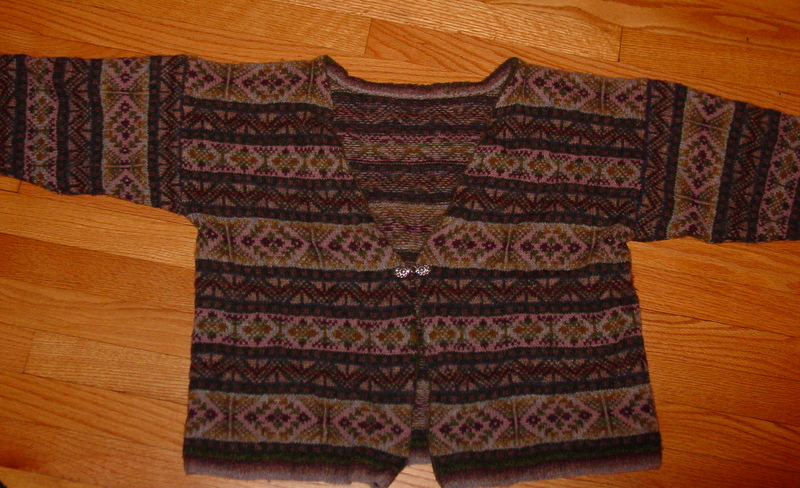
Oogy and I have decided that our focus this year is on stranded color knitting.  I've been a big fan of Fair Isle knitting for many years.  One of my fondest memories of the grad school years is spending several hours sitting on the floor in the shetland wool aisle at Shuttles, Spindles and Skeins in Boulder, Colorado.  I was with my buddy Julie and we were picking out yarn to make some Alice Starmore sweaters.  We kept poor Maggie running back and forth to check how many skeins of this or that she had in stock.  I made Rona, and Julie made Roscalie Cardigan, both from the In the Hebrides collection.  It must have been around 1995 or 96.  I didn't follow the pattern exactly, making my sweater a lot shorter and using plain ribbing instead of the fancy edging that Starmore called for.  Here is a picture of the sweater: 


Here's another project I did several years later--I used border patterns from Starmore's Book of Fair Isle Knitting to make this vest, using the fancy border that I was supposed to use on Rona.


Here are some swatches I am making in preparation for the next fair isle project, using Knit Pick's Palette:

    
So what does fair isle knitting have to do with the brain?  The basic structure of this type of knitting is the use of only 2 colors on any given row, with color changes every few rows to create the subtle variations that are so appealing in this knitting style.  It has a complicated appearance, but it is actually very simple, with a pattern that is repeated many times to complete the row.  For example, I used border pattern #159 from Mary Jane Mucklestone's 200 Fair Isle Motifs in the middle of the second swatch pictured above.

In a sweater the sequence of 16 stitches in the pattern would get repeated 21 times.  This is where the brain comes in.  The prefrontal cortex, which serves as the brain's executive processor, makes decisions and plans for the future.  It also houses our "working" memory, our ability to use new and remembered information to perform a task.  The dorsolateral portion of the prefrontal cortex serves as a template for spatial information.  It has neurons that will get active when something is happening in a particular place, and the same neurons will keep firing so that we can keep in mind what is supposed to happen in that place after a delay of a few seconds.  So, as row 1 in the border pattern is worked, the sequence of 1 Turmeric, 2 Bark, 5 Turmeric, 2 Bark, 3 Turmeric, 1 Bark, 3 Turmeric, 2 Bark...gets tracked by the dorsolateral prefrontal cortex and after a few repeats I can work the row without consulting the pattern, until all 21 repeats are done.  The spatial map in my dorsolateral prefrontal cortex is keeping the pattern in focus and directing the motor cortex to control the muscles in my fingers, allowing me to choose Tumeric or Bark, as appropriate.  Then, the pattern repeat, and maybe one or both colors, changes.  This taps into another function of the prefrontal cortex: it allows for flexible behavior that responds to changing demands of the environment.  Someone with damage to this brain area would be able to follow the pattern, but once it was established, it would be difficult for this person to shift to a different pattern.  But when the prefrontal cortex is functioning well, it is possible to replace the working memory for row 1 with the pattern for row 2.  Three hundred and thirty-six stitches later, things change again and the working memory is replaced for another row.

A different part of the prefrontal cortex is important for making decisions.  Should I do another row, or should I work on my lecture for next week?  The immediate reward of seeing the effect of the next color on the next row needs to be weighed against the benefit of getting the lecture prepared.  Do I really want to be up until 1am working on the lecture the night before it's delivered?  Or should I put the knitting down and get to work?  These decisions that involve delayed gratification are very difficult, but a functioning ventromedial prefrontal cortex can anticipate the emotional impact of an action, making it possible to make a decision.  I know from experience how painful and unpleasant it is to be preparing a lecture when I'm supposed to be sleeping, so the anticipation of this unpleasantness will factor into my decision, if my ventromedial prefrontal cortex is working.  

To see some figures of the prefrontal cortex and read about many other brain functions, check out a very cool site maintained by McGill University called The Brain From Top to Bottom.  The link will take you to the module that is focused on the function of the prefrontal cortex.  You can adjust the level of explanation from beginner to advanced, and you can also change the level of analysis, from neurological to psychological, or even social.

I have often thought that this type of knitting is one way to exercise the prefrontal cortex.  Maybe Fair Isle knitting can be used to strengthen the prefrontal cortex when depression and anxiety have been wearing it down.