Thursday, July 4, 2013

July Engineering

Dear Oogy,
I have found a few more UFOs that eluded detection last month, so I'll be joining you in extending those projects into July.

Here is my plan for our reverse engineering project for July: I plan to take some of the design features in this sweater
This is "Spice Variety Sweater" from last fall's Territory Ahead catalog.  A search of their website suggests that it is not currently available, probably because it is approx. 90 degrees outside.
 and use this yarn to make my own version.
The teal yarn is Oogy-spun alpaca!

The perpetual knitting pattern calendar will determine the portion that gets done each day.
I don't plan to make the sweater as long as the original, but I like how the individual patterns are put together.  You see that I didn't really get very far today, so we'll see how it goes.  We cannot be surprised on July 31st if we have another UFO on our hands.

It was very warm and humid today, which made working with the wool/silk/angora blend yarn a bit unappealing.  Brownie had this to say about it:
I hope you are staying cool, too!
Love,
Neuro

Tuesday, July 2, 2013

Weekly Brain Update: Working Memory


In an effort to bring more neuroscience to the Knit with your Brain blog, I begin this week with a new feature: Weekly Brain Update.  Each week the Society for Neuroscience publishes an issue of the Journal of Neuroscience.  This is a premiere journal with a broad range of neuroscience articles, including ones that are focused on cellular and molecular mechanisms, as well as ones that describe the neurocircuitry of complex human behaviors.  My plan is to choose an article from each issue and describe to you how the research relates to knitting.  My real goal is to motivate myself to read the journal every week; a secondary benefit will be to increase the neuroscience content of this blog.

A 16-stitch repeat that requires a hard working memory

One article from the June 26 issue has especially caught my attention.  It is about working memory and the brain mechanisms that allow us to hold information in our minds long enough to make links between events.  As a knitter, you might think about the process by which you learned the knit stitch, the sequence of events that had to happen in a particular order to form one stitch after another.  By the time you get to the step of transferring the completed stitch from the left to right needle, you needed to remember what was the first step from several seconds before.  After some practice, the sequence gets unified, and you don’t even think of the knit stitch as a series of steps anymore.  Working memory is the process of keeping the relevant information at the conscious level for a short time (it is also called short-term memory by some) so that long-lasting memories can be established by linking events together. 

The brain area that many believe makes working memory possible is the medial portion of the prefrontal cortex.  It resides in the front of the brain:  if you hold your pointer fingers alongside your nose, right up against your face pointing straight up, you’ll be pointing to the medial prefrontal cortex.  Someone who has trouble staying focused on a project might be experiencing some disruption in this brain area, which has been proposed as a mechanism for attention deficit/hyperactivity disorder.  Stress can disrupt this area, leading to a range of consequences that occur when the stress is severe or chronic.  

So you can see why it is interesting to find an article about the mechanism by which the prefrontal cortex contributes to working memory.  What turns out to be even more interesting about this article is that the researchers have used the most amazing new neuroscience tool: optogenetics!  Before this technique was developed the only way to manipulate a circuit in the brain was to inhibit or excite neurons near the circuit, or to alter the function of a single neuron, which provided very limited information about the whole circuit.  These old methods were also very slow compared to the processing speed of our amazing neurons.  With optogenetics it is possible to alter a very specific population of neurons for a very short time without affecting their normal function.  The neurons are altered by injecting a virus with a DNA sequence for a light-sensitive protein into a brain area.  Only a specific population of neurons will take up the DNA, depending on how it is tagged with a molecule that only that population of neurons uses (this is where my understanding of optogenetics is weakest).  Later, when the researchers want to alter the function of those neurons, they shine a laser nearby, which causes a reaction in the light-sensitive protein and either excites or shuts down those neurons.  If you want to know more about this technique, I highly recommend the TED talk by Ed Boyden: A Light Switch for Neurons.  I don’t think Dr. Boyden is at all confused about optogenetics!

Now, back to this week’s article.  Researchers at the University of Wisconsin-Milwaukee examined the role of the medial prefrontal cortex in forming a memory of an unpleasant event in rats.  Rats show overt signs of fear that we can see easily, in the form of freezing.  The rat remains very still for a period of seconds, sometimes minutes, allowing it to avoid detection in dangerous situations.  The researchers can easily control how dangerous a situation is to the rat, by pairing a sound with a brief foot shock. The shock doesn’t hurt the rat, but it is noticeable and not pleasant, so the rat pays close attention to the context and anything unique in the context (like the sound) in which this annoying event has occurred.  The greater the number of pairings between a noticeable sound and a foot shock, the more dangerous the sound will seem to the rat.   In that context or when hearing that sound, to the extent that the rat remembers, it will freeze for a period of time, depending on the magnitude of the perceived danger.

For the rat to benefit from this ability to sense when dangerous events are likely, it would need to link specific aspects of the situation that occurred close in time to the unpleasant event.  This can be examined by researchers who let some time elapse between the presentation of the sound and the foot shock.  This is a challenge for the brain!  Link an event that happened before to one that is happening later, when the neural trace of the early event would be gone.  Enter the medial prefrontal cortex, which is thought to somehow keep the information going when its source is no longer providing it.  Gilmartin, Miyawaki, Helmstetter, and Diba (2013, J. Neurosci, 33(26): 10910-10914) have provided evidence that the medial prefrontal cortex actually does this job.  They injected the medial prefrontal cortex of rats (which were anesthetized and positioned in a special frame that allowed the researchers to target the brain area accurately) with a virus that would deliver ArchT to the neurons there.  Then they implanted a tiny laser fiber just above where this light-sensitive protein was delivered.  They waited about 2 weeks for the rats to recover from surgery and when the light fibers were turned on, the neurons nearby shut down.  Their experiment was to turn off the neurons during the time that elapsed between the sound and foot shock, essentially removing the ability of the medial prefrontal cortex to keeo the trace in working memory.  They had a bunch of control groups in which the light was on at different times.  Then on the next day the rats were tested for the strength of their memory.  The rats that had the full function of their prefrontal cortex remembered both the context and the sound as scary.  However, if the prefrontal cortex was taken offline during the interval between the sound and the shock, the rats did not remember that the sound was scary.  This effect was very specific to the link between the sound and foot shock; the rats still showed fear in the context by itself.  The optogenetic technique allowed the researchers to turn off the brain area for a very short time,  a mere 20 seconds, which provided the evidence that was lacking to give the prefrontal cortex full credit for its working memory function. 
This would not be fun to do if we had to constantly consult the pattern.  Luckily our working memory keeps track of where we are in the pattern as each repeat is completed.
What would happen to our ability to learn the knit stitch if the medial prefrontal cortex was offline between “insert right needle into front loop of stitch on left needle” and “transfer newly formed stitch to right needle”?  We’d have to keep looking up the intermediate steps of “wrap yarn around the back of the right needle” and “draw loop on right needle through the loop on left needle” and the sequence would not get unified into a single event, the knit stitch.  We could tax the medial prefrontal cortex even more by trying to learn a lace or fair isle pattern repeat.  Next time you accomplish those amazing feats, consider thanking your medial prefrontal cortex!

Monday, July 1, 2013

FOs

Dear Oogy,
I've done all I can for our June project.
The fair isle vest is done.

I did try it on and it fits great.
I feel obligated to include a disclaimer: this is not strictly an authentic fair isle project.  First, it was not made with shetland wool, but instead with Knit Picks Palette, which is absolutely lovely with a color range that is hard to match.  I have a large portion of that color range in my stash, and one of the best aspects of this project was deciding which one to use next.  Second, I made no effort to align the patterns.  They are quite random in their horizontal placement.  I did, however, preserve a few features of a traditional fair isle project.  I used steeks, and I limited each row to 2 colors.  There are also 2 design features that I followed throughout the project.  One is that as I approached the top I chose patterns that were progressively shorter.  The other is that between each pattern is the same 2x2 design, with the same foreground color each time.  Now that this vest is done, I am quite eager to do another fair isle project.
The other FO is Clapo-Ktus.  This picture is just before it went in the sink.  It is now laid out on a table downstairs, beaconing Brownie to lay on top of it.

I liked making this shawl and I will use the pattern again.  One challenge that was especially an issue at the end was the effort required to drop the purl stitches to reveal the ladder rungs.  This is merino wool lace weight and has a bit of grab to it.  Brownie, as always, was a big help.
I'm excited to begin the July project!
Love,
Neuro

Thursday, June 27, 2013

June UFO Progress Report

Dear Oogy,
I know that I'm always expressing awe at how quickly time goes by, but really, what happened to June?
Of the four projects I identified as UFOs on June 1, two are slated for completion.  The lace shawl was repurposed and is close to being a completed Clapo-Ktus.  I had my doubts about the project until I reached the half-way mark, when it was then appropriate to let the purl stitches drop.  The opened-up pattern is just what this hand-painted yarn needed!

The fair isle vest is VERY close to being done.  Yesterday I cut the neck steek:
Before cutting...

The edges are secured.

The neck is free!

I wish I could say that all of my projects work out this well.  I'm too lazy right now to take anymore photos, but I can report that the neck edge is done, and I will cut the arm steeks in the next day or so.  More soon!
Love,
Neuro

Saturday, June 1, 2013

The New Area 51

Dear Oogy,
A confluence of UFOs have appeared in the fiber room.  Your suggestion for June was for us to "complete 4 UFOs".   Here are my 4:


The first is a lace scarf that I started a few years ago.  It is designed to form stripes from hand-dyed hanks, but as you can see, that effect has eluded me.  This is like my 4th attempt, which is why it has been languishing.  I do like the colors, so I need to decide if I will continue with the pattern, or start over.


The next UFO is a fair isle vest, inspired by your awesome xmas gifts of Palette yarn and Mucklestone's Fair Isle pattern book.  I won't have trouble finishing this, as it is nearly done, and I've been eager to get back to it.

A steek!

My 3rd UFO is a top-down cardigan made with shetland wool.  I may need to make some adjustments in the rate of increases, plus I'm not thrilled with how I did the increases.  I was making it up as I knit it, which sometimes works, but seems to not be working here.  I will complete this project, but I may need to pull it out a few inches.


Lastly, we have Virgin.  Remember that project?  The one we started as a KAL?  As you can see, I have completed a portion of one sleeve, and I began the body.  I have not even reached the complex asymmetrical pattern that will require sustained attention for approx. 200 rows of 252 stitches each.  What were we thinking?  How far did you get?  I'm leaning toward jettisoning this UFO, but I can be persuaded to change my mind if you've got yours half done already.  Or even started?  I seem to remember you were waiting for yarn that was backordered...
I can't wait to see your UFOs!
Love,
Neuro

Monday, May 27, 2013

It's still May

Dear Oogy,
I'm finding May to be a much better month than the extended April that finally made an exit.  I finished a scarf:
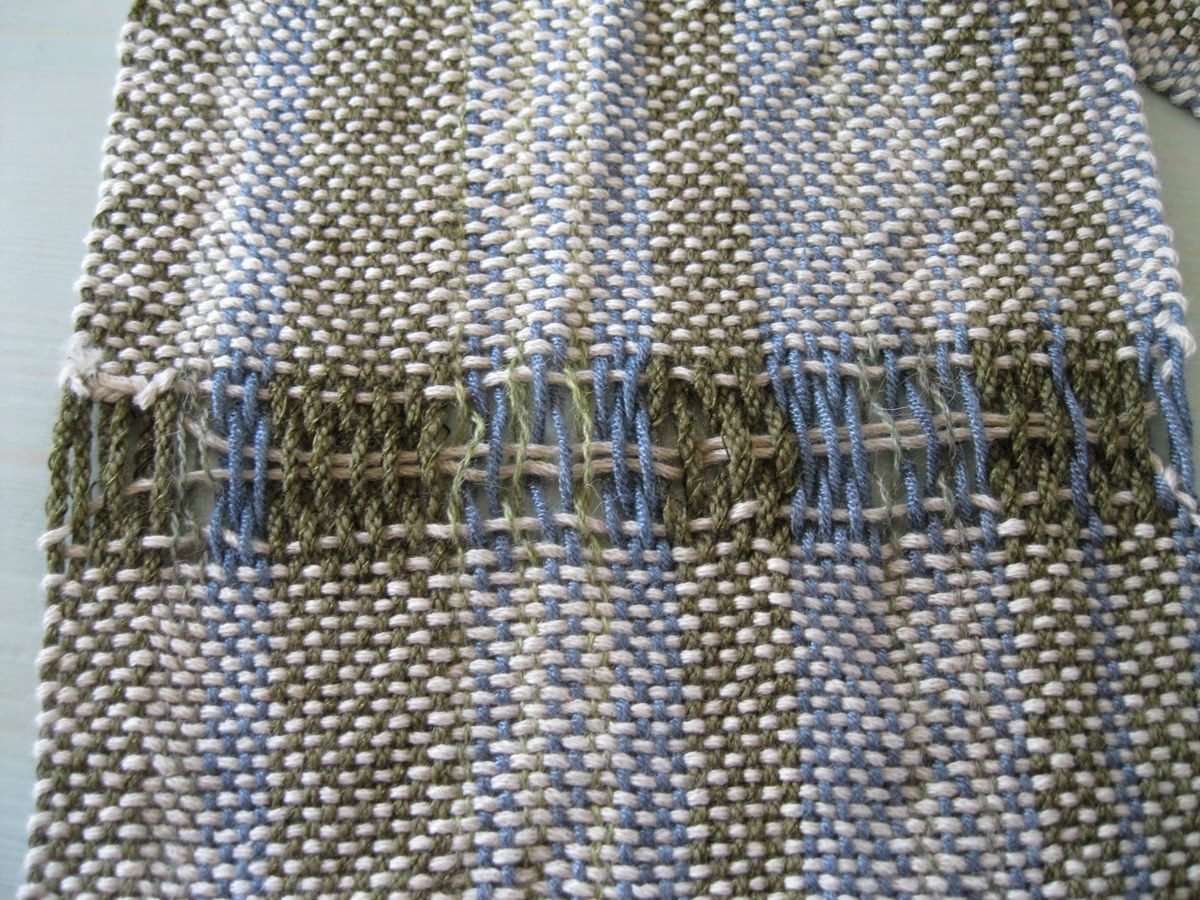
I'm calling it Organic Sugar Scarf.  The weft is organic cotton and the blue in the warp is yarn made with sugar cane.  I used hemstitching to secure the open warp areas.  I like hemstitching very much.
I also, with the help of Mr. Neuro, set up some shelves so that Brownie could observe his territory from on top of the book shelf in my home office/fiber room.


Unfortunately, he has also taken this gesture as an invitation to fling yarn from the cubbies below.
And I have also made progress on the project for May: knitting backwards!
The stitch marker that you can see just before the twist is where I began knitting backwards.  It is not difficult and is great for doing entrelac.  I'm working on a post that has a heavy dose of neuroscience, with a focus on how our plan to do something new each month this year is giving our prefrontal cortices a work-out.  Go PFC!
Love,
Neuro
PS.  How are we going to choose which UFO to tackle for June?  I have SO MANY.

Saturday, May 4, 2013

April's Extension

Dear Oogy,
It is becoming increasingly clear to me that April should have at least 45 days, not the usual 30.  April is the busiest month in our academic year, with year-long projects coming to fruition and students in a frenzy to both finish their degrees and get jobs.  Someone at work last week was joking that April seems to have been extended this year, and they didn't even know about how our Thing a Month plan is evolving into a Thing a Month and a Half.  While I am excited to tackle May's backward knitting in entrelac, it might be another few weeks before I have the energy to do it!

I guess another way to view our scheme is to say that we will BEGIN a new thing each month, with the idea that if it's fun, we'll keep doing it all year.  This is the approach I am taking to textured weaving.  I finished the place mats:
I liked the hemstitching so much that I used it again in a scarf.  When I used it in the place mats I did not understand how the hemstitching would secure the border--I now know that it can take the place of tying off the ends, but it is necessary to leave enough fringe so that the whole thing doesn't unravel.  Another texture element in the scarf is the intermittent placement of unwoven warp.  I thought there was some chance that the weaving was tight enough that the warp threads would remain open, but as soon as it came off the loom the weft crept in.
So, I did a little after-loom hemstitching, and now it looks great!
I suppose now I should expand my repertoire beyond the hemstitch...
Love,
Neuro

Sunday, April 7, 2013

April is for Weaving

Oogy and I are continuing the Thing a Month plan, and this month our goal is to expand our weaving skills beyond the basic plain weave.  We are novice weavers.  I had to look up what basic, no-frills weaving was called--imagine it being called "plain weave"!  There are many new vocab words to learn.

We are armed with Jane Patrick's The Weaver's Idea Book, which is all about ways to use the rigid heddle loom to make a whole range of woven fabrics.  It's a great book.  Right now I'm making some place mats with a hemstitched border.  I'm making 4 mats on the same warp, leaving about 6 inches of unwoven warp between them.


The warp is 3 colors of long-neglected stash yarn in cotton or cotton blend (no idea what the black yarn is or where it came from, but it feels like cotton).  The weft is cotton that I used for many attempts at a summer sweater.  It seems to have found its true destiny here.

Sunday, March 17, 2013

Intelligent Knitting

Dear Oogy,
As I listened recently to a colleague lecture about intelligence I found an idea that relates very well to this month's knitting project: fluid and crystallized intelligence.  Psychologists tend to view intelligence as having multiple forms.  Fluid intelligence depends on the ability to use new information and develop new skills, and to view information with a unique perspective.  Crystallized intelligence depends on the ability to store and retrieve information.  So there's how much you know and how well you use it!

I believe that learning to make socks two-at-a-time is helping us build our fluid intelligence.  Certainly we could say that the standard approach to making socks, one-at-a-time and from the cuff, is part of our crystallized intelligence, and with perhaps a bit more practice we can add these other techniques.    


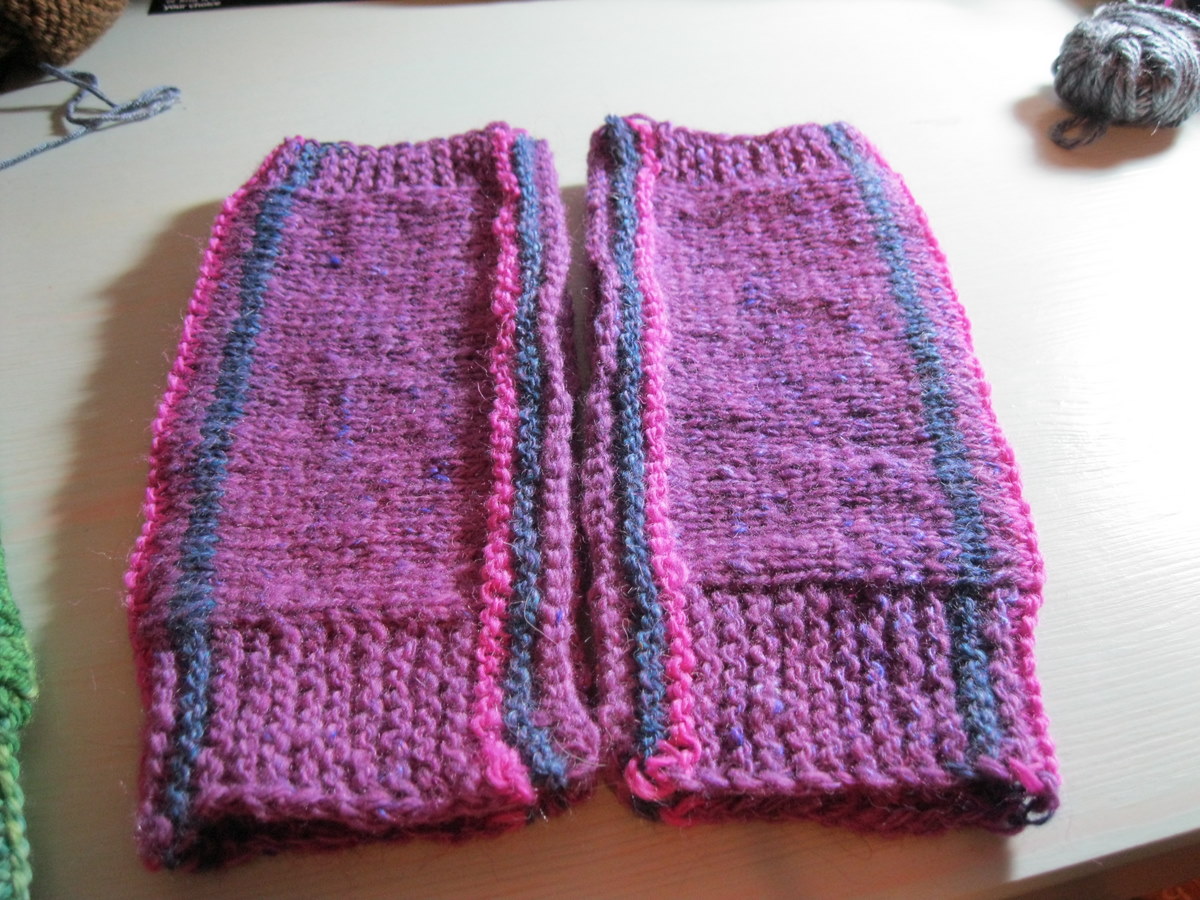
I finished my toe-up, simultaneous socks.  Instead of making them thigh-highs, I decided to make a matching set of mitts.  I found Judy Becker's magic cast-on to work very well (thanks for the link!) for the socks, but I encountered the same problem you had casting on when I began the mitts.  Oh, what a tangled mess I made.  Plus, it made me very mad.  Knitting hasn't made me so mad in a long time.  So, I did what you did: began with dpns and after a few rows transfered it onto the circulars. 

Maybe I'll try to exercise my limited amount of fluid intelligence and cast-on some cuff-first socks for the next project...
Love,
Neuro


Posted by Picasa

Sunday, March 10, 2013

Simultaneous sock progress

Progress, as promised!
No sign of an "N" in the sock, but the pseudo-striped pattern is cool.
Later the same day: the heels are turned and the gusset has begun.


Posted by Picasa

Saturday, March 9, 2013

March On

Dear Oogy,
Your magic loop socks are fabulous!  I also am missing my DPNs, but our goal this year was to break away from the routine, so I'll keep the magic loop thing going for another pair.  I have to say that my Thing-a-Month effort for February was not stellar, so I am pleased to welcome March and hope to make up for it.  I am making significant progress on the Simultaneous Socks from one of the sock blanks I dyed.  You think that decorating yours with an O was bizarre--I've decorated mine with an N.  It appears backwards half the time, but this will not matter because it won't translate into an "N" on the sock (I'm fairly sure).

How the sock appears so far...
Sock blank before knitting
I have an excuse for my abysmal showing in February.  It seems that most of my family members were born in February and early March, and this year I got it in my head that I was making gifts for everyone.
Mitts for SIL Diane (leftover Silver Scrumptious!)
Mitts for stepmom (they got discarded after I washed them and they grew 2 sizes that day)
Even better mitts for stepmom.  You may recognize the yarn, which you spun and we dyed at your MIL's.

Mitts for niece K-T.  
Hat for nephew Steven.  Mr. Neuro suggested I make him herringbone something.
Hat for brother Rob (and another exactly like it for brother Ron)
And then there is a colleague who has just had his first baby, so booties were in order.
Faux cable booties for Logan
I promise to give regular updates on the March progress!
Love,
Neuro

Saturday, February 16, 2013

Progress in the toe-up department

Dear Oogy,
I am happy to report that my toe-up training is going well.  I completed a trial toe and made a heel going the wrong toe-first direction.  With great confidence I have decided to go for a real sock, using the Happy Choices yarn you sent last month.
I am also using the magic loop method, in a show of solidarity with your own efforts.  I have not ever knit directly from a sock blank, so that is also a new experience.  
The practice sock is on the left.  
Just think of all the new synaptic connections we are making this month!
Love,
Neuro

Monday, February 4, 2013

Collaborative Knitting AND blogging


Dear Oogy,

I’m so glad that you came up with the “Thing-a-Month” concept for our 2013 knitting theme.  The BFF Cowl project for January was a great success!  I have worn my linked cowl most days since it was completed.  It’s cold out there!

Here they are together.  Mine is in Arrow Pattern (written by Hildegard Elsner and found in A Second Treasury of Knitting Patterns by Barbara Walker) in Silver Fiberspates Scruptious Aran; yours in the very original Our Favorite Things design, in Slate. 

You know how some projects turn out great, but while you’re making them you have serious doubts?  I did not experience that while I made the lacey link for our cowls.  It took me very little time to decide what pattern to use, and then I estimated how many stitches would give me 6 inches across and went for it.  It was exactly 6 inches wide and I was able to fit a complete number of pattern repeats to make it 26 inches long.  No project has ever gone more smoothly.  AND, I was not dreading the 2nd link.  In fact, it gave me the opportunity to use a new skill—smooth left-leaning decreases that I learned from Annie Modesitt. 

While all of that was great, what made the project most exciting was anticipating what you would send.  You always make the most interesting and awesome projects (for example, my most prized socks are fancy ones you’ve made), so I had high expectations.  I did not, however, expect to see actual chemistry, with beads and bobbles depicted on your contribution to the cowls.  It’s extraordinary and I love it! 

Here's a close-up of yours:


It’s February already!  I am working on my first toe-up sock.  It’s going well, but I’m worried about the heel…

Thank you for being my knitting guru!

Love,
Neuro