Sunday, January 10, 2021

Therapeutic Knitting Takes on Many Forms

I’ve long been a fan of Betsan Corkhill’s website Stitchlinks, which is focused on using the process of knitting to enhance wellness.  Corkhill has worked in a pain management setting as a therapist, and over the years she has developed the idea of Therapeutic Knitting.  Her ideas and how she got them is covered in her book Knit For Health and Wellness: how to knit a flexible mind and more, first published in 2014. 

In Chapter 8 of her book she identifies eight types of knitting projects and explains how each one can contribute to well-being.  She encourages knitters to have multiple projects going at once, allowing someone to turn to the project that suits one’s needs at any given time. I was able to relate my own multiple projects to the list:

Radiant Star Cowl from Shetland Wool Week 2020 Annual
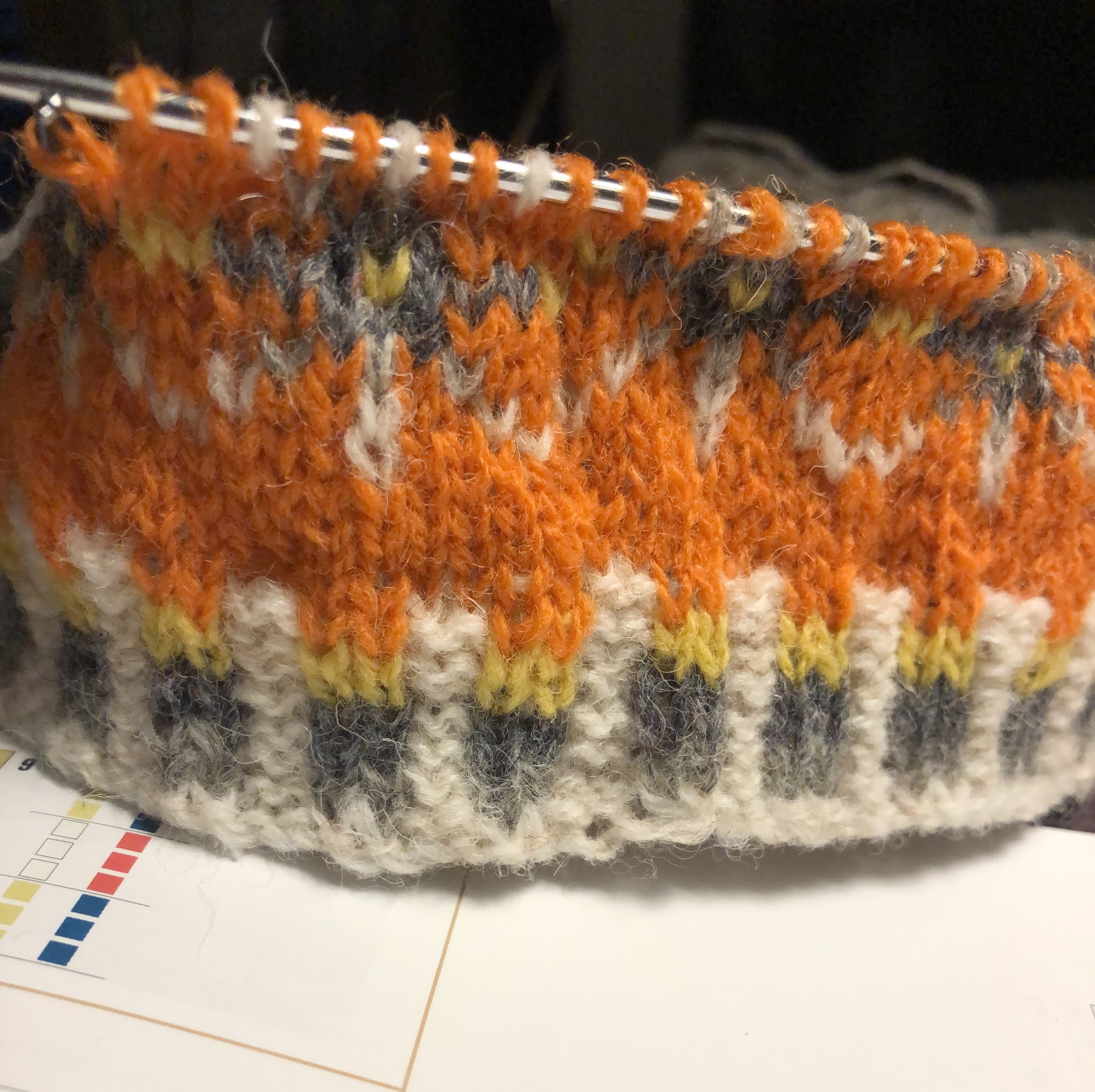
1. Intricate: A Fair Isle cowl that has 6 colors, and 3 repeats of a 29-row pattern.  It most certainly requires focus and close attention to the color chart.  This intense focus has been a great tool for taking a break from all the worries and uncertainties of the pandemic world we’re in. After reading Corkhill’s chapter, I realize why I always have either a Fair Isle or Shetland lace project at hand.


2. Novelty: The Christmas ball for one of my SILs for Xmas and stocking that I made for a charity.  The tree ornament had a distinct shape and it was necessary to follow a pattern that I haven’t worked on in a few years.  The stocking was a new design on a standard template that I developed a few years ago.  The stocking is a commission in which I have asked the recipient to donate funds to our local family shelter. 
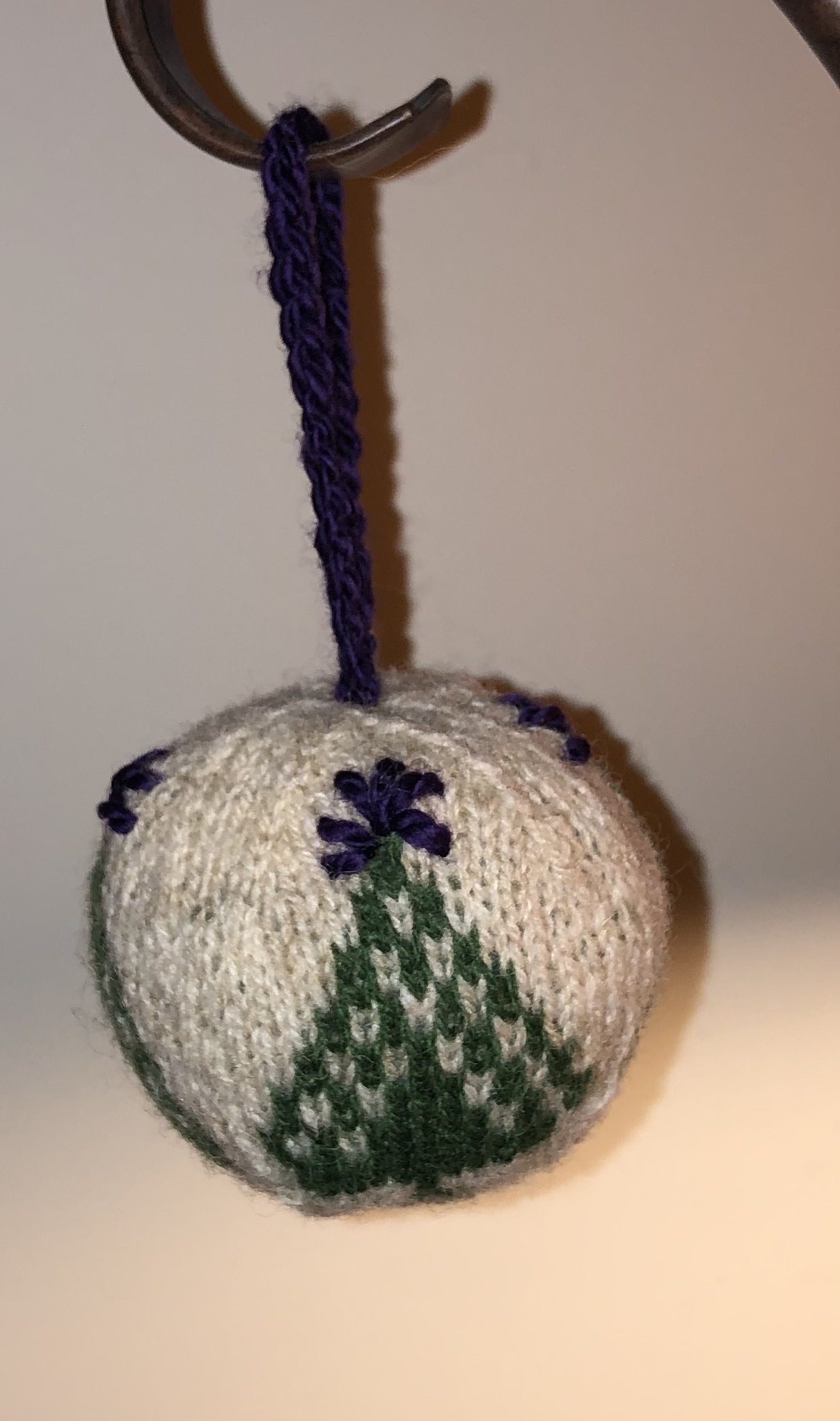
Arne & Carlos Ball #22

3. Automatic:
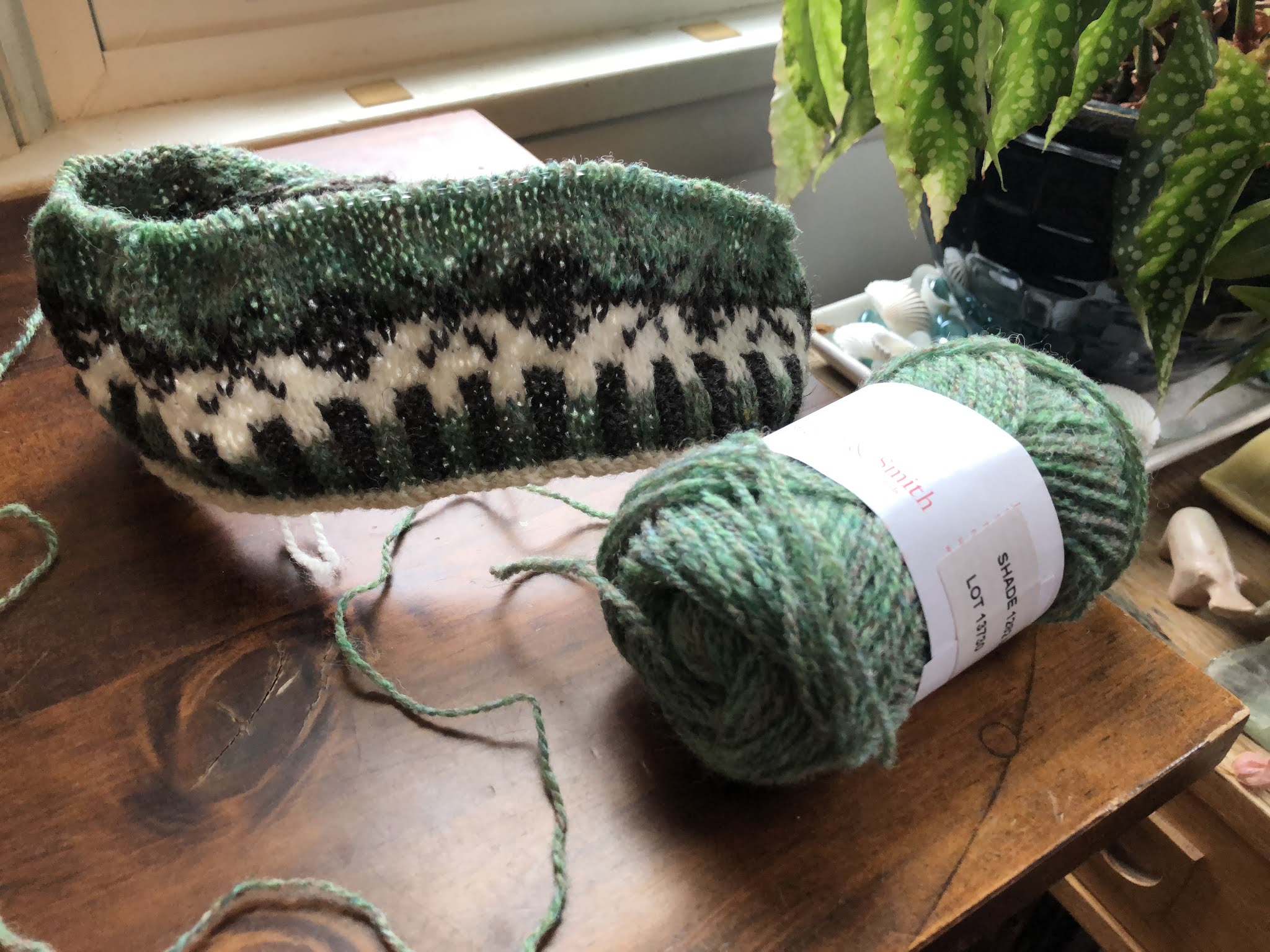
I’m making myself a yoke cardigan from the Wool Week 2020 Annual.  The pattern begins with a sleeve, which has 7 color-change rows before there are many, many rows of knitting one color in the round.  Doesn’t get much more automatic than that!  This project has been great for those Zoom meetings when I don’t need to take many or any notes. Just angle that camera up a bit and knit away!
Also great for webcam watching...


Strom Cardigan from Shetand Wool Week 2020 Annual
4. Group: The Camel Knitters, still meeting most every week since December, 2006.  Corkhill rightly suggests doing your Automatic knitting at this time. She also describes the benefits of doing a group project, which we have done in various forms over the years.

5. Big: I participated in the Sharon From Security knit-a-long a few months ago.  My shawl took on blanket proportions, so it was certainly big. This type of project is one that is expected to take a while and can be finished whenever the knitter decides enough is enough. For me that was several rows short of the pattern’s end.  The Big project going at the moment is a redo of a large sweater that I made last year that I can’t wear.  It was in Vogue Knitting and was designed by Deborah Newton. I’m generally a big fan of her designs, but this sweater looked very bad on me.  Sometimes it takes a year to accept that reality. I ripped it out and am using the yarn for a different sweater (see # 8 below).
Making it up as I go along...hopefully a bulky raglan sweater that I can actually wear.

6. Quick-fix:
The Xmas ornament (see #2) might qualify as a quick-fix. It was done in a day, although that was a day when I had set aside lots of time to knit. I have discovered a new “quick-fix”: wrist warmer/fingerless mitts based on the Switching Modes patterns.  I’m going to write a pattern for them, and call them Mode Mitts.


7.  Bag: Until it gets too big, that would be #3 above, and Mode Mitts would also work. Corkhill suggests that we have a portable project that can alleviate the pain of waiting in line, waiting for an appointment, waiting for the bus/plane/train to reach its destination. 

8.  Free Knitting: I started to make a poncho that has been designed on the go.  It’s one of my favorite types of knitting.  You really have to accept that the final product might be a total fail.  It’s all about the process.  This is probably how I will approach Big Sweater Redux. I have converted what began as a poncho into a “bed-poncho” for the recipient to wear while sitting in bed watching TV.  She seemed rather pleased with it!


So, of these eight categories which one best describes your current favorite project? 


Monday, November 16, 2020

Extending Wool Week

Shetland Wool Week was supposed to happen Sept 26-Oct 4 this year, but as the organizers have said, this is a "gap year".  They did an awesome job putting a large number of events online that are still accessible at their website.  This was the first year I could "attend" any of the events, because I'm not free to travel at that point in the year while I'm teaching.    

Recently I've been perusing the Shetland Wool Week Annual 2020, and there are at least 3 items that I plan to make.  In fact, I just finished the first one!

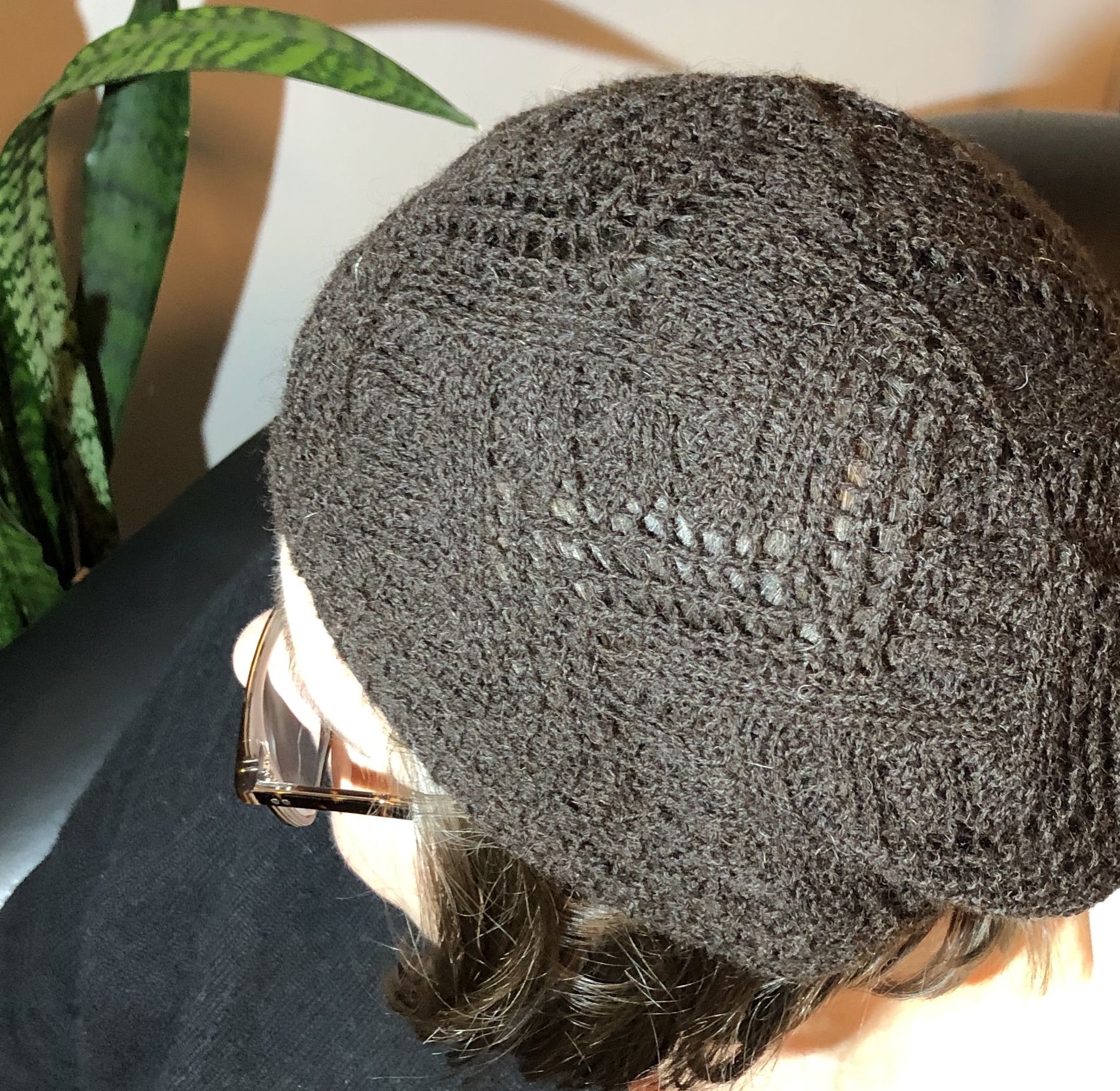
It's called Da Skaw Beret.  The pattern calls for 2-ply Shetland lace yarn in white, but I only have 1-ply in that color, so I made mine with 2-ply in black. It's actually a very dark brown.


It's not an especially warm hat, but it did a good job keeping hair out of my face in all the wind we've had.  

Next up, once my order from J&S Woolbrokers arrives, is Strom Cardigan.

Friday, October 23, 2020

Safety Orange

I have mixed feelings about deer hunting season. Deer are everywhere, including my city back yard.


I'm used to sharing my Hostas and birdseed with them, and it's fun to see the fawns every year.  But, I don't like the idea of them running out of food in the winter and starving.  So, hunting is a necessary remedy to over population.  

This time of year is a challenge for anyone in a rural area who would like to be out and about.  Anytime I've been up North during the deer hunting season I see folks walking down the lane wearing bright orange as a precaution.  

This is what I plan to wear:

Jamieson's Shetland Spindrift + Mucklestone's 200 Fair Isle Motifs


Happy Fair Isle Friday!
 

Saturday, October 17, 2020

Next

For the past year, and especially this summer, I've been busy making lace in anticipation of two very important weddings.  Both of my little brother's kids made their wedding plans for this fall, and because I have recently been immersed in Shetland lace, I decided to make each of the brides a shawl.  I made bride number 1 a small crescent shawl in a bright pink color using baby merino wool from Malabrigo.  I do wish I had remembered to take pictures of the finished product.  I will keep alive the dream that I will see her wearing it someday and get a picture then. Here is a shot of it before I blocked it...


For bride number 2, whose wedding was yesterday in the rain, I made a rectangle shawl in a soft blue color using baby alpaca handpaint from Misti Alpaca. 

I used the traditional Shetland lace pattern called "candle light" for both shawls.

I'll give lace a short break now!


Thursday, October 15, 2020

New hat update

 I have learned a strategy for getting through long Zoom meetings: mindless knitting.  This was one reason that I wanted to start a hat last weekend, so that I would have something to keep my hands busy while attending meetings remotely.  This strategy only works for meetings that don't require me to be a continuously active participant.  For example, I would not knit through a department meeting that I was chairing!  Yesterday I attended a 2 1/2 hour meeting that I was originally going to attend in Chicago.  Instead of 2 travel days and nights in hotels, I was able to observe from my home office.  I probably was able to process more of the details of the meeting that way than if I was there in person.  So, it's not all bad, this Zoom thing.

Plus, I made significant progress on the hat:


After watching some of the Shetland Wool Week events online I began to yearn for a Fair Isle project.  Now there is (another) reason to look forward to the next Zoom meeting!


Monday, October 12, 2020

A much needed break

I signed up to teach an accelerated course, packing 15 weeks of content into half that time, meeting with my class over Zoom 4 times a week.  It's been going well except that I can barely keep up with the constant preparation (teaching online takes longer to set up!) and I'm behind in grading.  Plus, I'm on a big committee (akin to a faculty senate) and I'm co-chairing my department. It seems like I am complaining, but I do feel fortunate 1) to have a job that I like and 2) to be healthy.  

I finally decided to take a day off, to enjoy a beautiful autumn day last weekend.  

I started a new Fair Isle hat.  It's design is only a vague idea rattling around in my head at this point.  I've actually already started it over since this picture was taken.


It was a beautiful day, so I was able to sit on the patio and enjoy the last of the season's flowers.

Then I came inside and worked on a weaving project that has been on the loom for many months.  I was learning some new techniques and am glad to be done with that experiment.  The feline helper decided it was useful as a pillow.

It was clear that he was having trouble keeping his head up.

Crashed!


Sunday, September 20, 2020

Candy Corn

I used up all of my purple yarn making a few of Casapinka's emPower People bandana cowls, which was super fun and an excellent mindless project that I could manage during Zoom meetings when I wasn't expected to be an active participant.  I'll admit to working a few rows in some more serious meetings, too.  How does anyone get through so many meetings without a mindless knitting project to help them through so much screen time?  

I'm not complaining about Zoom meetings--I actually like them.  I also like teaching class using Zoom.  Most people don't feel this way, and I am considering what that means about my general attitude toward my work... I guess it's good that I haven't started knitting while I'm teaching! 

But the real problem is that I need a new mindless project to get me through more meetings.  In the process of dyeing yarn for another project, I decided to use the left-over dye on a generous (~130 g) skein of sock yarn.  I'm calling this colorway "candy corn".


But, what mindless pattern to use? 

Thursday, September 3, 2020

What week is it?

Brownie here.  Hey, if Casapinka lets her cat write shawl patterns, Neuromomma can let me write a blog post!

This mystery shawl gig is working out rather well for me. Neuromomma sits still for longer periods of time, stays out on the patio until its really dark so I can see lots of shrews, and now it's big enough for me to sleep on.  Thanks Sharon!  By the way, I think that you are really cute, and I wish I could see your floofy tail in person.  


Saturday, August 29, 2020

Week 3 is over

but I'm still knitting clue #3.  Not very well, I might add.  After section 14 I had 5 extra stitches, which I only discovered when those 5 extra stitches made themselves known at the end of the first lace row of section 15.  TINK... You can't even tell that there are 5 K3tog on that first lace row now!


Then, I failed to follow the lace pattern.  It was meant to be "feather and fan" which has plain rows separating the rows with decreases and yarn-overs.  My version is more like "crest of the wave" with no plain rows.  Sharon will run out of citations when she sees this rendition of her design!

Wednesday, August 19, 2020

At the end of week 2...

 and still not sure I like what I see.

Keeping my faith in the impact of blocking, I will forge ahead!

Saturday, August 15, 2020

Week 2 of The Sharon Show

It's been fun to participate in the MKAL The Sharon Show.  I decided to use yarns that I had on hand, and 2 of the colors are speckle/ombre dyed, which the designer warned us might not look great in this project.  The combination of the colors at first felt very jarring to me, but I'm getting used to them and have started to like how they are working together.  


Monday, August 10, 2020

Scrappy Coasters

The minute Oogy informed me that July Gift was coasters made with left-over yarn, I knew what I was going to make.  

Over the years I have accumulated a large quantity of Shetland wool for various Fair Isle projects.  This process began when I was in grad school when a pal and I got addicted to making Alice Starmore projects.  Her typical Fair Isle sweater has at least 10 colors, often more than that.  With that many colors in one sweater, you can imagine that there was often left-over yarn in at least a few colors.  I’d make a little ball of each one and stuff it into a basket or bag with left-overs from the last project. Over the years the little balls waited for their final destiny, and for some that was just revealed a few weeks ago.


Every knitting tradition has a long list of interesting facts in its history and practice.  One reason that Fair Isle projects often have so many colors is that Shetland knitters waste nothing.  When I visited Fair Isle way back in 2018 my host showed me a portion of the South Lighthouse that she was setting up as a knitting café, where folks could meet and work on their knitting and drink some coffee.  There was a cupboard filled with small quantities of yarn of various colors and weights that she had accumulated over the years.  Soon she had friends sending her their left-overs, and the cupboard was filled beyond capacity.  She was planning to invite anyone who visited the café to make use of anything in the cupboard—a sort of community yarn stash! Just a few months ago I found a used book called Knitting Fair Isle Mittens and Gloves, and Carol Rasmussen Noble described how the typical Shetland yarn stash gets built: there isn’t much time in the summer to knit because the croft work is endless, so any yarn that was used in the previous winter, or is otherwise acquired during the rest of the year gets stored in a cupboard.  Then, when it’s winter and there’s nothing else to do but spin and knit, the contents of the cupboard get some action. 


It’s far from being winter here, but I decided to use Fair Isle techniques and a vessel of little leftovers to make the July Coasters.  One of the most important techniques in Fair Isle knitting is to make a sizable swatch to test the color combinations and make sure that whatever pattern motifs you’re using actually work together.  Fair Isle knitting is usually done in the round, and the swatch is done by knitting across the row, and then pulling the yarn around the back to begin the next round.  Once the swatch is done, you cut through all the long strands that connect the end of the row with the beginning, making it possible to lay the swatch flat and determine if all is well.  I got in the habit of saving these swatches, trimming the strands on either side, and using them as a buffer between indoor plant pots and furniture. 


For my coasters I would essentially make a swatch that would be wide enough to work easily in the round.  I used steeks to separate the coaster portions so that I would be able to make the frayed edges on either side later by cutting the steek-knitted portion.  Unlike a normal swatch, these were going to be intentionally felted. 


I cast on 160 stitches, used 31 stitches for each of 4 coaster portions, and 9 stitches for each steek. I started with a peerie border pattern and developed each OXO pattern on the fly from there.  It was so much fun!  I enjoyed recalling that the pink yarn was from a very early Starmore project, so it had been waiting in the “cupboard” for nearly 30 years.  The purple was left over from a Webcam hat, as was the burgundy, orange and yellow.  The greens were stash occupants for decades. I had a sneezing fit when I started using the few little scraps of teal in the final border pattern and was reminded that it was left over from yarn I brought to a motel in Maine in 1995.  The motel room reeked of cigarette smoke, and it was still in the yarn 25 years later! 


Once all the knitting was done it looked like yet another cowl!  I took it for a hot, soapy, turbulent swim and after much time and agitation it emerged appropriately dense.  Once it was dry I used the sewing machine to zigzag the side edges of each coaster portion to prevent any unexpected unraveling.  Then, time for the scissors! 


The felting process was more complete than I expected, so the edges are not fraying at all.

Sunday, August 9, 2020

Roving to Yarn

Spinning three pounds of roving seems both daunting and enticing.  It looks like a large quantity of wool in those bags!  It is rare that a knitting project is quick—even “quick” projects take many hours.  The 3-season cape, which will also be known as the 3-pounds-of-roving cape, is going to be a simple design, but capes are meant to be a top layer and so it will need lots of positive ease.  I’ve enjoyed musing over design ideas while I spin.


The only way to enjoy spinning is to have a wheel that is in good working order.  Mine started squeaking a few weeks ago, and although I applied some oil to the screws that connect the foot pedals to the wheel, the annoying squeak persisted. I had a silly idea that letting the wheel sit for a few weeks would solve this problem.  Maybe the air was too dry or something?  Ha!  Viruses and squeaks do not just disappear!


I came North this time armed with Ballistol Multi-Purpose Lubricant.  There’s an extensive array of applications listed on the can, including firearms, knives, and leather, but nothing about annoyingly squeaky spinning wheels.  The foot pedals on my wheel are connected to the drive wheel with leather straps, and these are often the source of the squeak.  The leather gets dried out over time and stops bending enough.  A few squirts of Ballistol fixed that!  Now the wheel is quietly generating lots of twist and the singles are flying onto the bobbin. 

So far I've generated 3 skeins.
Add caption


Tuesday, July 7, 2020

Roving in Hand


I’m delighted to have my paws on 3+ pounds of Border Leicester/Romney cross roving from the Formerly Unknown Sheep Farm.  This of course is not what it’s called, but I’m loath to reveal my location for security reasons.  Not that my identity hasn’t been blown on this blog, but let’s just pretend.


I chose a pound of “white” which is really a cream-colored cloud.  I plan to dye some of it, but also spin some undyed to go with the light grey/brown roving.  I have 2 pounds of this color and am planning to make a 3-season cape.  Design to follow.


I’m happy with my test skein, and have started the long-term project of spinning the rest. 


Neurocat also is grateful and approves of my choice.


Sunday, June 28, 2020

Lace Appeal Returns

I find the process of knitting lace to be very appealing.  I like how a small quantity of yarn can become something so big and beautiful.  A single 50g skein can yield 6 ft of airy and delicate lace! Well, almost... Lace’s appeal took a slight detour for me when Oogy and I attempted to make traditional Shetland lace in the form of Dunella.  It’s still on the needles, and it’s fate is yet to be determined.  While that simmers on the back of the hob, a few other lace projects have emerged, starting with “Elemental”, which I showed you a few weeks ago.  

I got to working on a pattern from Victorian Lace Today called "Scarf With the No. 20 Edging from The Knitted Lace Pattern Book, Thompson Bros., Kilmarnock, Scotland, 1850".  I'm thinking of a new name.  It has two wide borders that are joined by a short connecting pattern.  It calls for 600 yards of lace-weight yarn, and I have a collection of 400-yard skeins of baby alpaca in various natural shades, so I thought I would use 3 of those, one for each section of the scarf.  After finishing the first border and having more yarn remaining than expected, I decided that it would be better to make the scarf just one color. So, I made the second border narrower and hoped with every row that I would not run out of yarn.  I was even weighing the yarn as it became a smaller and smaller pile and was sure I had enough.  

Well, that did not work out very well.  Unravel the second border and go back to plan A?  I couldn't bring myself to do it.  Instead, I decided to finish those last 8 inches with a similar color of the same type of yarn, and then dye the whole thing a darker shade to cover up my unfulfilled optimism.  

There is another feature of lace knitting that keeps me hooked: how blocking transforms the finished piece.  Once the knitting is done, it looks like a crumpled mess and you wonder why you spent so much effort and eye-crossing hours following the tiny grids of the pattern. 
My special assistant is always willing to secure a project so it doesn't blow away.

Then it goes for a swim, as Oogy describes it, and gets stretched out to dry and achieve its final form.  
I dyed the finished scarf with a combination of "caramel" and "fuscia"

The variation and darkness of the new color disguises the color change.
With my lesson in having ample yardage still quite fresh, I have started a new project. I'm designing it myself, which is to say I have decided to do 9 repeats of the "candle light" pattern from Elizabeth Lovick's The Magic of Shetland Lace Knitting with a simple 6-stitch edge on each side.  
4370 yards.  I should have enough this time.
Half blocked, just to see how the pattern would look and what edge it would yield.
That’s the real magic of lace!