Sunday, March 4, 2012

Focus on Socks

The demands of work have meant that I only have energy to make one sock after another (and to write very short blog posts).  The only way to make it fun is to use wonderful colors.  

From this assortment, my step mom chose teal blue, slate blue and deep purple.
Her yarn looks like this and is in line to be knit into socks soon.  Dad's socks are first (lilac and slate blue).  There are some lightly-dyed strands of pink, but we won't tell him (he's color blind and only wears the socks in the house).

I've put my own on hold (golden pear, slate blue, pine green).

Sunday, January 29, 2012

Brain Shifting Progress

Another milestone reached in the fair isle project: the second border pattern is done!
Brownie is shown because I know how much you love him.  He is not at all aware of, nor does he care, what is happening here.

By now the knitting is probably not requiring much prefrontal cortex.  I don't need to look at the pattern chart anymore, and I get through half a row thinking of other stuff before I realize where I am.  A few times this weekend I was surprised to find myself at the end of a row.  Interestingly, I can immediately tell if I've made a mistake.  Then I have to carefully consider the pattern and figure out where I am.  It happens about once every other row.  I believe that's a function of the striatum, which responds to the mistake by halting ongoing behavior.

What keeps me addicted to this project is watching the color progression.  I love each of these colors and it's fun to see how they look together.

The next step is to do another peerie, like the one that separates the first and second patterns, and then it will be time to begin the all-over pattern.

As I'm working on this project I think of all the stories I've read about the knitters who originally used this technique to make garments for their families or to sell.  They would do the work while they were doing "real" work, like farming or gathering wood.  Walking around getting things done while managing to make such intricate pieces.  I could work on my sweater and lecture at the same time!  Maybe not.

Saturday, January 21, 2012

Striatum-dependent knitting

There's been some progress made on the fair isle project:
The first motif on the body is finished.  I changed the colors in the center to add further contrast in the background.  It looks a bit loud here, but the red-orange color will brighten up the sweater without being too overwhelming (I hope).  It's been so much fun getting re-immersed in fair isle knitting.  I love how the pattern evolves on every row, even though each row takes forever (364 stitches, #2 needles).

I've also been working on the Virgin sweater:
I started with the sleeve because I was too lazy to do a swatch.  Luckily my gauge is right, although the yarn I am using (Brown Sheep Nature Spun sport weight on size 3 needles) is not producing as dense a fabric as the pattern calls for.  The safety pin is placed at the point when I felt I was not using my prefrontal cortex excessively to keep track of the pattern.  The next marker, where I stopped knitting to take this picture, is where I felt the knitting became primarily striatum-dependent.  By that I mean that I could knit without paying much attention.  I had developed the habit necessary to following the pattern without having to keep it in working memory.  As each row was worked I was able to recognize that I was changing the yarn appropriately, getting a little pulse of dopamine in the nucleus accumbens each time.  I put it away to play with the fair isle sweater, so I'll need to use my prefrontal cortex for a few rows when I get back to it.  I'll need to reclaim it from Mr. Brown, who has recognized its value as a pillow.

Sunday, January 8, 2012

Fair Isle Knitting: the ideal prefrontal cortex exercise

Oogy and I have decided that our focus this year is on stranded color knitting.  I've been a big fan of Fair Isle knitting for many years.  One of my fondest memories of the grad school years is spending several hours sitting on the floor in the shetland wool aisle at Shuttles, Spindles and Skeins in Boulder, Colorado.  I was with my buddy Julie and we were picking out yarn to make some Alice Starmore sweaters.  We kept poor Maggie running back and forth to check how many skeins of this or that she had in stock.  I made Rona, and Julie made Roscalie Cardigan, both from the In the Hebrides collection.  It must have been around 1995 or 96.  I didn't follow the pattern exactly, making my sweater a lot shorter and using plain ribbing instead of the fancy edging that Starmore called for.  Here is a picture of the sweater: 


Here's another project I did several years later--I used border patterns from Starmore's Book of Fair Isle Knitting to make this vest, using the fancy border that I was supposed to use on Rona.


Here are some swatches I am making in preparation for the next fair isle project, using Knit Pick's Palette:

    
So what does fair isle knitting have to do with the brain?  The basic structure of this type of knitting is the use of only 2 colors on any given row, with color changes every few rows to create the subtle variations that are so appealing in this knitting style.  It has a complicated appearance, but it is actually very simple, with a pattern that is repeated many times to complete the row.  For example, I used border pattern #159 from Mary Jane Mucklestone's 200 Fair Isle Motifs in the middle of the second swatch pictured above.

In a sweater the sequence of 16 stitches in the pattern would get repeated 21 times.  This is where the brain comes in.  The prefrontal cortex, which serves as the brain's executive processor, makes decisions and plans for the future.  It also houses our "working" memory, our ability to use new and remembered information to perform a task.  The dorsolateral portion of the prefrontal cortex serves as a template for spatial information.  It has neurons that will get active when something is happening in a particular place, and the same neurons will keep firing so that we can keep in mind what is supposed to happen in that place after a delay of a few seconds.  So, as row 1 in the border pattern is worked, the sequence of 1 Turmeric, 2 Bark, 5 Turmeric, 2 Bark, 3 Turmeric, 1 Bark, 3 Turmeric, 2 Bark...gets tracked by the dorsolateral prefrontal cortex and after a few repeats I can work the row without consulting the pattern, until all 21 repeats are done.  The spatial map in my dorsolateral prefrontal cortex is keeping the pattern in focus and directing the motor cortex to control the muscles in my fingers, allowing me to choose Tumeric or Bark, as appropriate.  Then, the pattern repeat, and maybe one or both colors, changes.  This taps into another function of the prefrontal cortex: it allows for flexible behavior that responds to changing demands of the environment.  Someone with damage to this brain area would be able to follow the pattern, but once it was established, it would be difficult for this person to shift to a different pattern.  But when the prefrontal cortex is functioning well, it is possible to replace the working memory for row 1 with the pattern for row 2.  Three hundred and thirty-six stitches later, things change again and the working memory is replaced for another row.

A different part of the prefrontal cortex is important for making decisions.  Should I do another row, or should I work on my lecture for next week?  The immediate reward of seeing the effect of the next color on the next row needs to be weighed against the benefit of getting the lecture prepared.  Do I really want to be up until 1am working on the lecture the night before it's delivered?  Or should I put the knitting down and get to work?  These decisions that involve delayed gratification are very difficult, but a functioning ventromedial prefrontal cortex can anticipate the emotional impact of an action, making it possible to make a decision.  I know from experience how painful and unpleasant it is to be preparing a lecture when I'm supposed to be sleeping, so the anticipation of this unpleasantness will factor into my decision, if my ventromedial prefrontal cortex is working.  

To see some figures of the prefrontal cortex and read about many other brain functions, check out a very cool site maintained by McGill University called The Brain From Top to Bottom.  The link will take you to the module that is focused on the function of the prefrontal cortex.  You can adjust the level of explanation from beginner to advanced, and you can also change the level of analysis, from neurological to psychological, or even social.

I have often thought that this type of knitting is one way to exercise the prefrontal cortex.  Maybe Fair Isle knitting can be used to strengthen the prefrontal cortex when depression and anxiety have been wearing it down.

Sunday, November 20, 2011

The perennial knitter's problem

I told Oogy I wanted to see something new on her blog, to which she replied she had nothing but unfinished objects [see her pile here].  Me, too, Oogy!
We are very good at starting something, but not as good at finishing.  I don't mean the Deborah Newton you-should-know-better-how-to-finish-your-knitting sense, but more the finish-SOMETHING-before-you-start-the-next-project sense.  I wish I could say this is my UFO pile in its entirety...
The green lace project has been targeted to be finished before the year of lace knitting is over.  Just 5 more repeats of the center panel (50 more rows), then the 12-row border to be repeated 86 times (1032 rows of 7-12 stitches each).  This is the deception of lace knitting: you're almost done, except for the border.

The purple and bright green items are for the community knitting project I'm doing with a group of students and the Camel Knitters.  We are making hats and mitts for kids at a shelter in our city.  We plan to visit the shelter's after-school program and do a knitting lesson soon.

Monday, November 7, 2011

New Inspiration

We are headed into the end of a year of lace, Oogy and I, so my eye is wandering to other possibilities.  I was inspired recently by a friend's sweater in progress, which you can see here (see the 6th picture).  My version will have a different design and will use the yarn pictured here.

Monday, October 10, 2011

gauntlet mitts and knitting as therapy

Sometimes I would rather be knitting, but if I can't be knitting, at least I can be wearing something that I knit.  These mitts have seen a number of hours at the keyboard recently.

Most of the knitters I know would agree that knitting offers some form of therapy.  I have often found it to be a soothing break from work, to take out my "office knitting" and do a few rows.  The therapeutic benefit of knitting (and crochet and cross-stitch) is being studied by a group in Bath, England.  Betsan Corkhill has a website called Stitchlinks that is very interesting.  She runs a clinic in which her clients use knitting or stitching to help them cope with chronic pain.  She's also convinced nearby neuroscientists to examine the impact of knitting on brain function.  I'm especially intrigued by the evidence for improved memory.

I sometimes will use knitting as a means to cope with frustration.  I'm making another pair of mitts for a friend who is experiencing some challenges.  I can't help her, but I can make her a pair of mitts.

Sunday, September 18, 2011

A Smaller Girasole


One of the lace knit-a-longs that Oogy and I have done this year is the shawl Girasole, a pattern by Jared Flood.  Hers is the larger, blanket version, while mine is the smaller, shawl version, made with Knit Picks Palette in Iris Heather.  I was so happy to find a use for that yarn, which has been languishing in the stash for years, with multiple false starts in other projects.  I was so dismayed when I ran out of yarn about 2/3 around the border.  Luckily, the additional skeins of Iris Heather I purchased were a perfect match.  When does that ever happen?

Saturday, September 3, 2011

Purple Pain

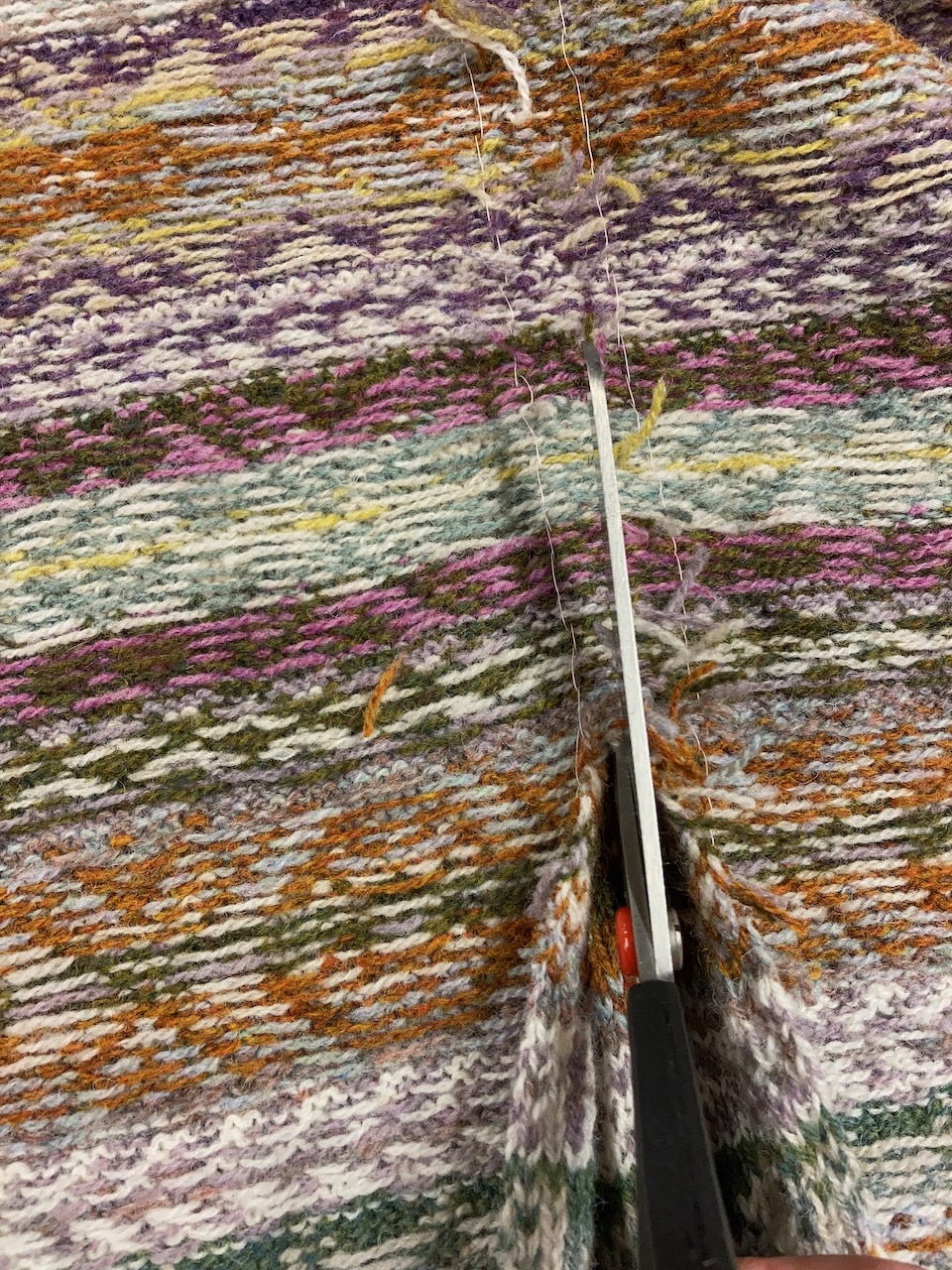
I've been thinking a lot about the experience my friends are having as they learn to knit.  They've gone into the endeavor with the idea that it looks impossible, only to learn that it's really quite easy, at first.  Then things get complicated, like when extra stitches appear, or the yarn begins to shed.  It turns out that knitting is really very complicated, and even with 25 years of experience, mistakes happen.  These thoughts came to me as I was tearing out the Lutz and Patmos cardigan that I made from a pattern in the Early Fall 2010 issue of Vogue Knitting.  I used a different yarn, but the huge dimensions were as directed in the pattern.  The problem was that such a sweater is not meant for a larger person, with it's chunky yarn and big cables. Cables every inch!  I've had it sitting in the closet for a year now, so today was the day it got dismantled.
 It looks so nice, laid out on the floor.  I actually tried it on again, thinking maybe it would be OK, but no, it still looked like a big robe.
 Brownie, ever the helper.
I have vague plans to use the yarn to make a simple (no cables) V-neck sweater, with a matching scarf.

Tuesday, August 30, 2011

Goodbye August


August has been a blur—transitioning from lab work to home modification work, and then back to school has disrupted the normal routine.  This has not, however, had a significant impact on the amount of knitting getting done around here.

August began with a great deal of activity in the dye “studio”, that area of the basement where the floor is colorful and jars of dye grow fuzzy things.  It got some serious use for a few weeks, as this picture demonstrates.  A good fiber buddy came over for an afternoon to observe and sample the activity (see her coverage of the event here). 

Once the dye studio was taken over by the home modification effort, my attention was shifted to teaching a colleague how to knit.  I even had the chance to meet her at the yarn store and show her some of the possibilities for her first project. 

She is off to a great start:


The process of learning how to knit has been going well for her, though there has been more than one session of “forensic knitting” in which I have closely observed her technique to discern how her scarf was developing holes and wings.  Initially, she was not completing every stitch, resulting in a slipped stitch and a yarnover, which turned into an eyelet on the next row.  We cured her of that habit, but then she developed a new symptom of knitting in the garter stitch row below, creating 2 stitches that should have been one.  We seem to have worked that one out, too.  It’s been a few days since I have heard about the scarf (Irene might have increased time to knit, but she has not fostered electronic forms of communication), but hopefully some good progress has been made. 

Saturday, July 23, 2011

Convolutions

Oogy has sent my cortex!  It turns out to be a tea cozy, which is so very awesome.  It's about 100 degrees out, but I'm going to make some tea, anyway.
She also sent a blank canvas--sock yarn ready and waiting to be dyed.  There's about 450 g here, so that's about 4 pairs of socks.  Good timing, because my order from Knit Picks of Bare lace- and fingering-weight yarn arrived on the same day.  Definitely time to fire up the dye studio!

Sunday, July 10, 2011

Yarn in DC


A few days away gives one a renewed appreciation for home. Going away, however, gives one an opportunity to discover new yarn shops! During a recent trip to DC (grant review meeting: lots of interesting work, great fun, hung out with a grad school mentor who was on the same review panel) I found Looped Yarn Works. After 2 days of reviewing grants in a windowless conference room, I was sprung loose on DC and went immediately, well, after a nice lunch with my mentor friend, to the yarn store. I was greeted warmly by the owners, Janie and Susan, and got a tour of the place from Janie. I'm a frequent yarn store visitor, so there isn't much that can be new for me, but Janie enthusiastically showed me some yarn that was indeed unique. It's created by Elisabeth Drumm and is also sold on her Etsy shop. It was difficult to choose which colors to get, and I now see on her shop that there is a vast range to choose from. The gradual color variation is achieved by changing the number of plies of each color, starting with all the same, then substituting 1, then 2, then 3, and finally changing the color all together. It's explained better by the artist on her shop site. Now for what to do with them...

Sunday, July 3, 2011

Annual Fawn Visit


It seems every year at this time we are introduced to a new family in the back yard. This photo was taken from inside the house today. As I write this the family is walking down our street!

Nature and Girasole Spin-off


Our year of lace is half over! I still have quite a lot of lace weight yarn left...
In the process of working on what is now the massive Girasole, I found myself liking Chart E. It's simple enough that I don't have to consult the chart anymore, and I like the fabric it makes: lacy but not too frilly. I decided to make a sweater with that pattern as a prominent feature. I'm calling it Girasole Spin-off, Chart E. I'm making it up as I go along, with the idea that it will be something I can wear when it's warm out (short sleeved, open in the front). This is what's been knit in the past week. One of my favorite things about lace is that it can be very fast to knit.

This picture shows it folded in half, with the left front on the left side of the photo. I'm using Rowan Purelife naturally dyed organic cotton in "rhubarb". I thought rhubarb had a pinkish hue, but this yarn is ever-so-slightly green, with subtle variations in intensity, plus the tiny area that I hand dyed with a bit of shiraz. That part looks more like what I imagined rhubarb to be.

Sunday, June 26, 2011

Oogy and I are tackling another lace project together--a "tidy" of all things. This would be a rectangular doily. Here's my progress thus far:
It is a pattern called Apple Leaf Tidy and is available for free here.

Saturday, June 11, 2011

Camel Knitters Yarnbombing


Today is the inaugural International Yarnbombing Day, which the Camel Knitters Guild observed at Connecticut College.

We had only 4 days notice, but we manufactured a good number of these, uh, squiggly things.


Saturday, May 28, 2011

Unilateral Sheep

Almost forgot...here is the sheep scarf. It is missing one sheep. The pattern is written so that at the end of the first ball of yarn the stitches are held while the pattern is repeated for the second half. When the second half is done, the halves are grafted together to make the scarf with 2 sheep ends. When I reached the end of ball 1, I decided I was happy to keep going with the pattern and see how it would look with one sheep. I think it looks rather sophisticated, especially with how the border pattern transitioned from the main pattern.
This is an extreme example of how $4 worth of yarn can become something really cool.

Mystery Shawlette Part 2

It is so exciting to see this develop.

Getting help with Girasole

After cruising through charts A-C and starting D, I decided to unravel to the middle of C because I had made a mistake there. I saw it a few rows before C was finished, but decided it wasn't very noticeable...but it really was once I got into chart D, so back I went. The cat was kind enough to offer his help.
This pattern is fun--not too difficult and as the rows get longer and longer, I find the repetition very relaxing. It is a nice break from the mystery shawlette, which I believe is rather more difficult (but still fun!).

Thursday, May 19, 2011

Mystery of Lace Knitting


When I have time (when the grades are in) I will post a bit about dopamine and the anticipation of rewards. For now, you can see that I have agreed to an official knit-a-long, to make a shawlette. Care to join me and Oogyknitter and hundreds of other lace hounds? See the pattern at WendyKnits' site here.

I had some Malabrigo lace weight yarn, aptly named "purple mystery", left over from another project. The pattern is for fingering weight, but lace is forgiving, and I'm using a size 4 needle. It looks great so far!


Friday, May 13, 2011

flat sheep


Funny story: I started the sheep scarf and noticed that in the instructions it states that a blank box is "knit every stitch", which I interpreted as "knit every right side stitch, purl every wrong side stitch". I paused ever so slightly when both edge stitches were supposed to be "slip one purl-wise", which I thought was odd because on one side that made a big mess. So, I proceeded to knit (and purl) through the sheep pattern, and I liked what I saw. Then I saw oogyknitter's version (see her blog) and realized that I was doing it wrong. Well, actually, I initially assumed oogy was doing it wrong, but then I looked at the instructions again.
Anyway, I am quite happy with my version and plan to continue to do it wrong!

finished cat's paw


I'm including an actual cat for scale. He's about 15 inches long in this position.
I've been wearing the scarf every few days this past week--it's perfect for the chilly mornings.
Now on to Sheep Scarf!

Interactive brain site

One of my students alerted me to an interactive site that features parts of the body, including the brain. It's really quite remarkable. Check it out here: healthline body site

Saturday, April 30, 2011

CT Sheep and Wool Festival


I made a short visit this afternoon to the CT Sheep and Wool festival. It was great fun to be immersed in fiber in all its forms, from live animals to roving to yarn. I found some shetland/soy roving from Cobblerock Ridge farm, pictured here. No, I didn't buy all of that! Just 15 oz in light and medium brown.

cat's paw progress


Back to lace! I was at about the halfway mark when this picture was taken last week--I'm now at the 3/4 mark. I'm looking forward to the next lace project. This one has grown tiresome.
Oogy, what is the next project?

Monday, March 21, 2011

Products of Harpswell Knit Inn

Here are the projects that the Knit Inn participants manufactured in the span of 2 days. We had a discussion of color perception and started the projects on Friday night, and worked on them, along with other projects, through Saturday and by Sunday morning we were able to view them all. The idea was to demonstrate the impact of context on color perception. For example, the yellow diamonds in the burgundy and navy backgrounds appear different, although they are made with the same yarn.
Our other endeavor was to make ornaments.

A very productive and enjoyable weekend!

Saturday, March 12, 2011

Finally, some neuroscience on this blog

I didn't forget that this blog is about neuroscience. I'm preparing a very informal "workshop" for a weekend knit-away at Harpswell Inn in Maine. I enjoyed the experience last year and agreed to give this year's event a bit of neuroscience. Well, actually, I agreed to do a workshop on color knitting, but it's really going to be a geek fest of color perception, complete with diagrams of the eye and the primary visual cortex. I'm making a few sample vessels with Knit Picks' Wool of the Andes to demonstrate simultaneous contrast. The "pumpkin" appears darker on the "lake ice heather" background compared to its appearance on the "black cherry heather" background. Felting adds an element of mystery and fun to the project. I have an array of colors for workshop participants to play with, so I hope it will be fun.

Lace continued

This is the progress so far on Cat's Paw. I'm using Knit Picks' Alpaca Cloud in Moss, which might be a bit faded after sitting in a basket languishing for several years. It's an easy pattern.

Tuesday, March 1, 2011

Wabenschal Finished


I've even worn it a few times.

Now I am focused on finishing Moon River. Oogyknitter has gotten way ahead of me!

Maybe I'll post something related to neuroscience soon...

Sunday, February 13, 2011

San Francisco Treat

A recent visit to Artfibers, on Sutter Street in San Francisco, revealed a smorgasbord of yarn, accompanied by multiple swatches that displayed some of each yarn's possibilities.

I was warmly invited to "taste" whatever I wanted. Because this year is all about lace, I had pattern in hand (Moon River Scarf--see Ravelry for free pattern download) and some idea of which yarn to try (prior web-based research: Artfibers catalog). I thoroughly enjoyed sitting at a picnic table to make my swatch. The store/studio is on the 3rd floor with floor-to-ceiling windows at each end. It was a beautiful day and being there was such a welcome respite for the brain, which was taxed to its limit preparing and meeting to review grants. About an hour into swatch-making revelry, my preconceived notion of making Moon River with "Brie" was replaced with an unexpected appreciation for how "Carezza" was better suited for the purpose. The owner, Roxanne, seemed pleased to accept my offer of the mind-changing swatch for her collection.


You can see how the shop is set up, with the yarn in bins below the display of swatches. It's an awesome concept that is a must-see if you are lucky enough to find yourself in San Fran.

After a day on the plane to return to the dirty snow-ridden Northeast, I have over a foot of Moon River to my credit. Oogyknitter and I have established another knit-along with this pattern. It is a very easy one!

Monday, February 7, 2011

work stoppage imposed


I decided after finishing the first sleeve that I wanted more of the grey color in the sweater, so it can be seen more prominently in the partially finished sleeve. I haven't decided exactly how the body of the sweater will look yet.

There have been multiple attempts to stop work on the project by my so-called assistant.